From NZ Racing Desk
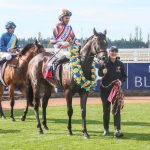
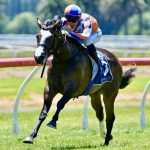
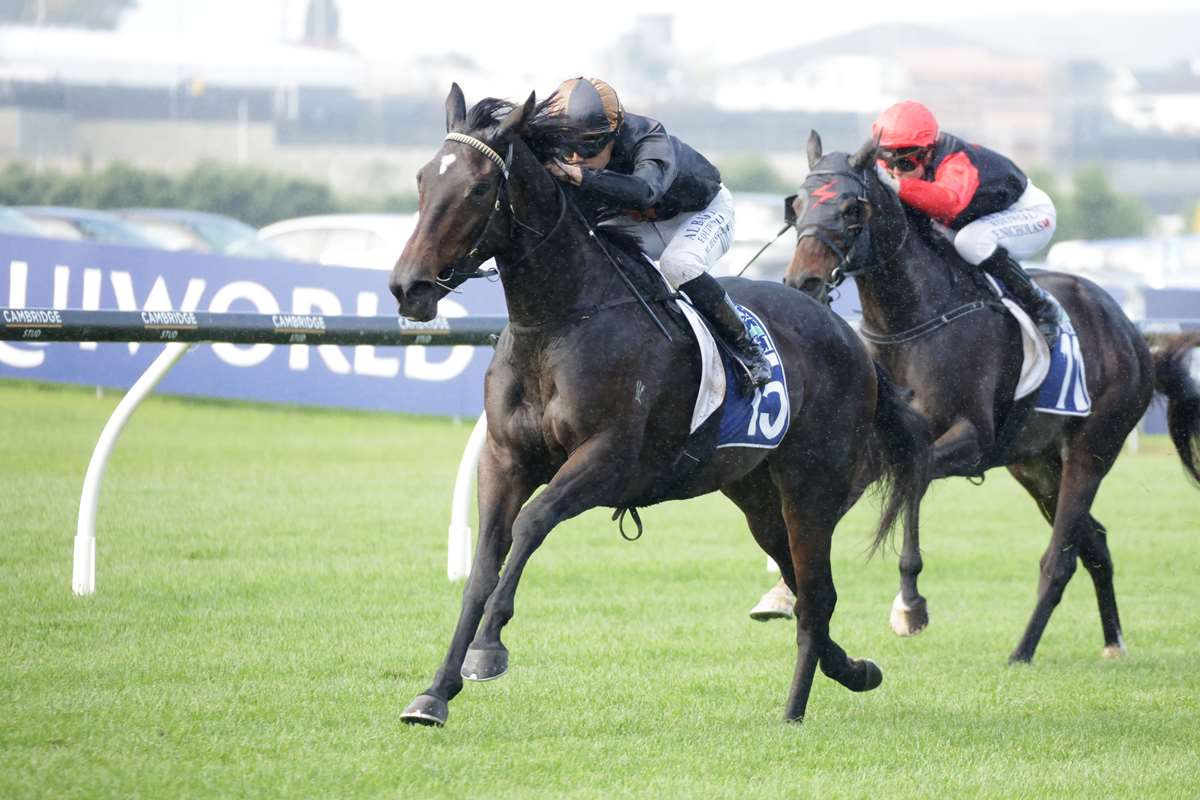
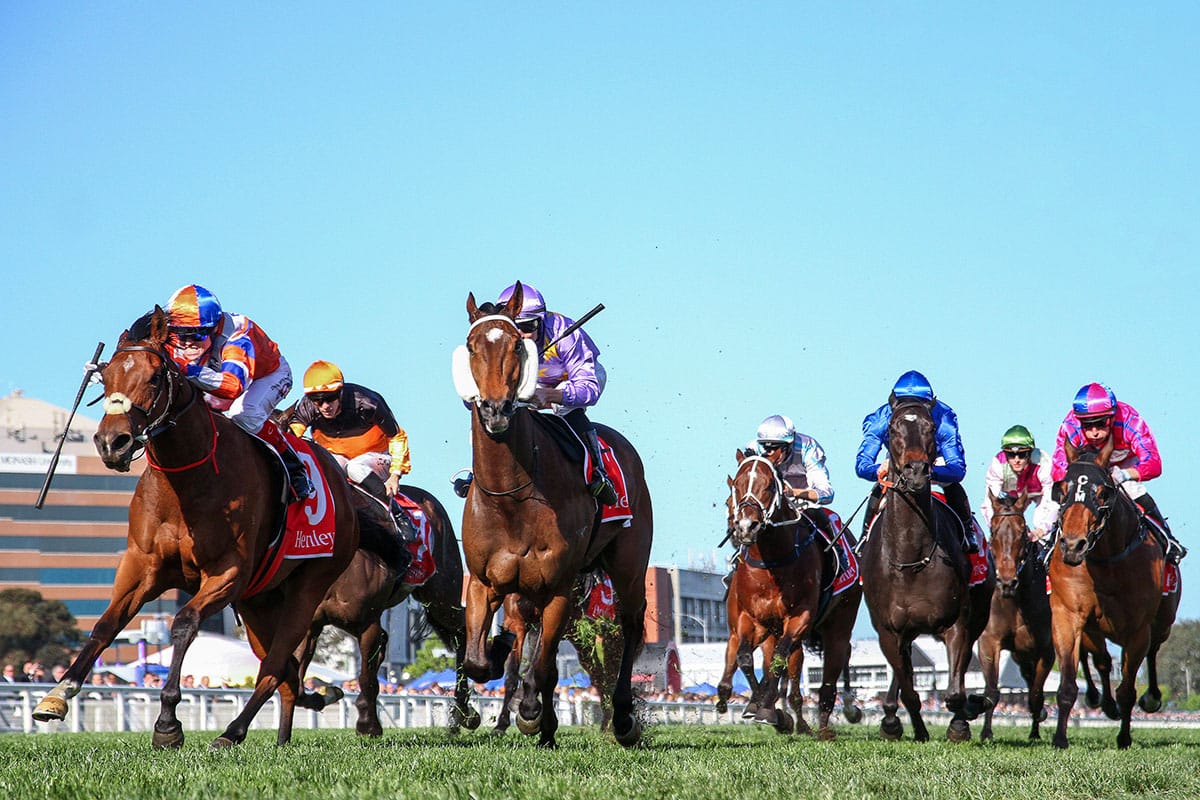
Given what he has experienced with Bellatrix Star (Star Witness) the past two seasons, Mark Walker is taking a cautious approach with the classy sprinting mare as she edges towards a return to the races. That is slated to occur this Saturday in the A$200,000 Gr.3 Sir John Monash Stakes (1100m) at Caulfield. The weight-for-age event will be Bellatrix Star’s first start since finishing last in the Listed Doveton Stakes (1100m) last November, her only outing since finishing down the track in the Gr.1 Champions Sprint (1200m) more than 12 months earlier.
Runner-up to Switzerland (Snitzel) in the Gr.1 Coolmore Stud Stakes (1200m) the start prior, Bellatrix Star hasn’t had the opportunity to scale the heights Walker considered her destined for as a mare, but he remains hopeful the rising five-year-old has more to achieve. “We’ve had a lot of problems with her and she’s been off the scene for a long time,” Walker said. “She had an accident coming home from the swimming pool, she fractured her neck when a loose horse ran past and she reared up and fell over. We got her over that, then she had her first start back and she chipped a fetlock and had to go for fetlock surgery. That’s just racing, you take the good with the bad. She’s still very lightly-raced, so if she ran well on Saturday, hopefully we get things back on track.”
Bellatrix Star has won five of her 12 starts, the highlights being Group Two wins in the Eclipse Stakes (1200m) in New Zealand and the Schillaci Stakes (1100m) against the older horses the start before the Coolmore Stud Stakes. The daughter of Star Witness has been given a steady build-up, including two trials and two jumpouts, the latter at Cranbourne last Monday when she was a convincing two-length winner over Midnight Devil (Hellbent) and Pinstriped (Street Boss).
Craig Williams, who was aboard for Bellatrix Star’s Schillaci Stakes win, was aboard for the latest workout and Walker considers it a positive the premiership-hunting jockey is sticking with her on raceday.“It was encouraging that Craig rode her in the jumpout and he’s riding her raceday, so that gives us a bit of a push,” he said.
Bellatrix Star was one of 19 entries for the Monash Stakes, with her list of potential rivals headed by Matt Smith’s classy gelding Headwall (Dream Ahead).
Raced by John Galvin’s Fortuna Racing, Bellatrix Star was offered by Phoenix Park in Book 1 of Karaka 2023, where she was bought for $80,000 by Fortuna Racing in partnership with Te Akau Racing principal David Ellis.
=====================================================================
What Japan gets right
Here is a thought provoking piece by the Sydney based Bloodstock Agent, Will Johnson
Sunday morning, coffee in hand, and Sydney has that particular stillness it gets when half the city has decamped to Europe for the summer. The Wallabies went down to Ireland in a nail biter overnight, Aidan O’Brien won the Coral Eclipse (yet again), and Saratoga is wrapping up its meet.
I’m heading to Hokkaido later this week for the JRHA Select Sale. But before the overnight flight, I thought it was worthwhile spending some time looking more closely at the Japanese thoroughbred industry, not just the horses but the structure underneath them.
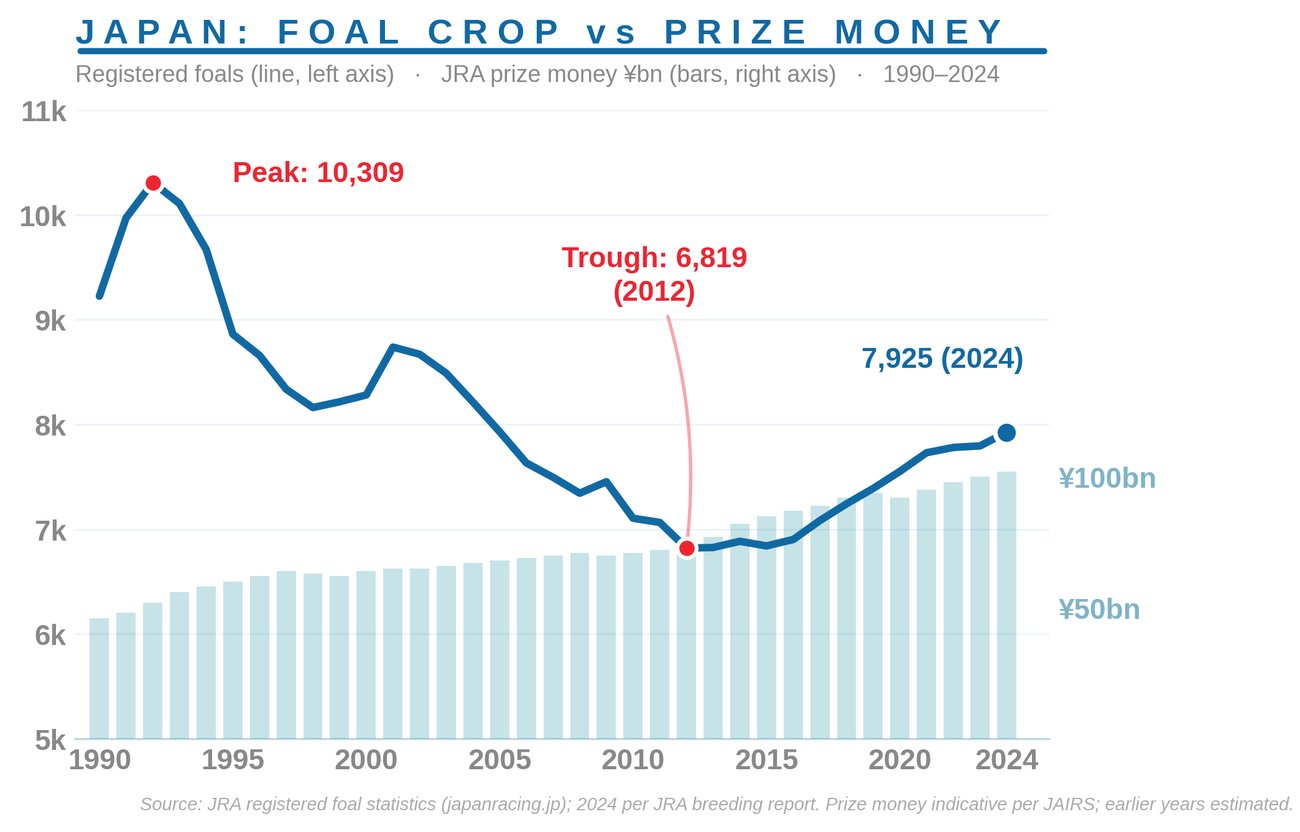
With our own numbers in the back of my mind: Australia’s foal crop is heading for its lowest point since the 1970s, despite prize money that has never been higher. We are not in a position to lecture anyone. Which is exactly why Japan is worth studying, because Japan has been where we are, and found a way back.
A PROTECTED WAGERING MARKET
Start with the most important structural fact. Legal wagering on racing in Japan exists for exactly four codes: horse racing, bicycle racing, motorboat racing (quite amusing on YouTube) and motorcycle racing, all operated by public or quasi-public bodies.
There is no fixed-odds sports betting market, no commercial bookmakers, no global operators competing for the racing dollar. A modest football pools product and the national lottery sit alongside, and a first casino resort is under construction in Osaka for around 2030, but the wagering landscape racing occupies is protected in a way no other major jurisdiction can claim.
Elsewhere the story is very different. In Britain, sports betting takes a growing share of total turnover. In the United States, most states have legalised sports betting since 2018, and racing’s share of the gambling market has continued to fall. In Australia, wagering operators compete in an increasingly crowded market with no particular loyalty to racing.
Whilst our government moves to place further restrictions on gambling advertising, the pokies, the slot machines affectionately known here as the ‘tradie’s laptop’, continue to get a free run at the gambling dollar. Meanwhile the emerging wave, prediction markets like Kalshi and Polymarket that let punters trade on everything from elections to economic data, hasn’t reached Japan either.
Racing in Japan doesn’t fight for the wagering dollar. It owns it. That insulation is policy, not geography, and it is the foundation on which everything else is built.
The JRA processes over ¥3 trillion in wagering annually, roughly one and a half times the entire North American racing handle, across a fraction of the race days. That revenue funds ¥102 billion in prize money, ten metropolitan racecourses maintained to a standard most jurisdictions can only aspire to, two elite centralised training centres, and the broodmare incentive programmes behind one of the more interesting supply-side recoveries in global racing.
A second tier, the NAR, runs seventeen local-government racecourses with its own graded programme, and it was the contraction of this tier through the 2000s that drove the foal crop’s decline.
CENTRALISED GOVERNANCE AS A COMPETITIVE ADVANTAGE
The JRA is a government-authorised public corporation under the Racing Act, overseen by the Ministry of Agriculture. Racing in Japan is a public utility, not a private club dressed up in regulatory language.
Every licensed trainer and jockey operates out of Miho or Ritto. No private yards. Officials have direct, continuous access to horses and participants. Drug testing runs through JRA-operated laboratories. Stewards are permanent employees. The integrity record that produces is exceptional by any comparative measure, and the structure makes consistency far easier to maintain than in jurisdictions where regulation is fragmented across multiple bodies.
I saw the transparency side of this first-hand, because the dataset I built for this piece came straight from public JRA and JAIRS records. Not just foal registrations, but broodmare returns going back decades: how many mares were covered each season, how many were barren, how many slipped, how many foals were lost at or after birth. Every covering certificate, every foal return, available to anyone with an internet connection.
The information a breeder in Hokkaido works with is the same information available to a buyer in Lexington or Newmarket. In an industry where information asymmetry has historically been a commercial advantage for insiders, that is a meaningful policy choice.
THE FOAL CROP RECOVERY
Here is where the Japan story diverges most sharply from the rest of the world.
Over the past 35 years, Japan’s foal crop has collapsed, stabilised, and recovered. From a peak of 10,212 registered foals in 1992, registrations fell to 6,660 in 2012, a 35% drop driven by the closure of regional government racing authorities through the 2000s, which gutted demand at the volume end of the market. Once that shock worked through the system, the floor held. Broodmare numbers recovered from 9,253 in 2014 to over 12,000 by 2024. The foal crop followed, reaching 7,925 registered foals in 2024 and holding near 8,000.
The contrast is instructive. North America’s foal crop is down more than 65% from its 1986 peak. Britain’s stallion population has contracted sharply, and Britain and Ireland’s combined crop recorded its steepest year-on-year fall in fifteen years. And Australia, as I said at the top: more money than ever, fewer horses than at any point in fifty years.
Japan has recovered. Now we need to do the same thing elsewhere.
WHAT HOKKAIDO REPRESENTS
The JRHA Select Sale is fifty years of deliberate industry building expressed through a sales ring. Northern Farm and Shadai Farm have assembled broodmare bands that compete with anything in Kentucky or Ireland, built through decades of patient importation and development rather than one cycle of speculative investment.
Japanese-trained horses have won the Melbourne Cup, the Saudi Cup and, last November, the Breeders’ Cup Classic, with Forever Young becoming the first Japan-trained winner. The Arc remains the one that got away: El Condor Pasa run down by Montjeu in 1999, Orfevre’s infamous drift into the rail in 2012. That pursuit, and what it has required Japanese breeding to become, says more about the industry’s ambition than any winner’s trophy.
Nobody else is getting Japan’s wagering monopoly. That door closed decades ago. But the things that actually turned Japan’s foal crop around, broodmare incentives that paid breeders to keep mares in production, centralised integrity that earned public trust, breeding data open to everyone – none of that requires a monopoly. It requires a decision. Japan’s recovery isn’t a story about unique circumstances.
It’s proof that when an industry chooses its structure deliberately, the supply follows. Every jurisdiction watching its foal crop shrink has that choice available. How each navigates an ever-changing gambling landscape to help fund that, will take some imagination.
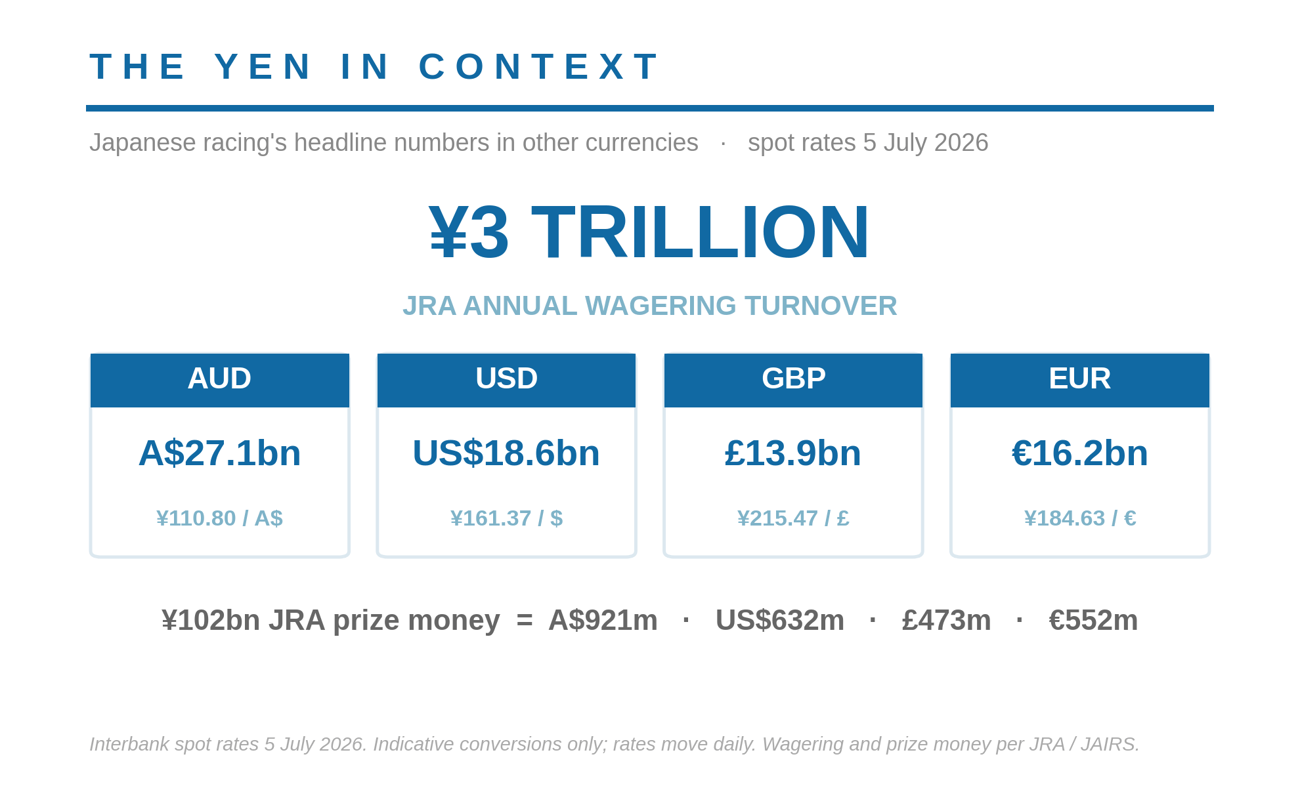 John adds – my research indicates as follows
Wagering turnnover (in AUD) – Japan 45 billion, Australia 30 billion, USA 16 billion, HK 15 billion Great Britain 6 billion, NZ 1.5 billion
=====================================================================
Guest Commentator – Des Coppins
Greetings John and Friday Flash Readers
With the curtain call for racing at Avondale next Wednesday imminent it’ll be a sad time for the majority of all in the racing industry who have followed the sport in the area since day dot! So many great gallopers have graced the track. So many wonderful memories for us all, too.
What the future holds for the course remains uncertain with a few questions still need to be answered. For instance will the site be developed in to an urban sprawl and will the Auckland City Council step in? Understandably the racing industry will be out to get the best result dollars wise. NZTR (with the approval of the Minister of Racing) has the legal authority to process the sale and disburse the funds as it sees appropriate and hopefully in due course it’ll be a fair outcome for all.
Leaving the politics aside I’d like to share with you some of the great horses that starred at Avondale in those halcyon days which I’m sure, like me, many of Friday Flash readers really enjoyed.
FORGOTTEN RACES MAYBE BUT NOT THE WINNERS!
Interestingly over time Avondale was a very innovative club. However, it may well have been put to the sword with the introduction of night racing in the last 1980’s. It was in a tail spin of serious debt faced with a financial decline it never really recovered from. I read somewhere that the installation of floodlights and related infrastructure cost several million and when the stock market crashed almost simultaneously the rot set in and step by step Avondale began to lose key races and traditional dates.
In its heyday day, Avondale introduced “ new races” to its programmes. Some remained for a few years while others became “one hit wonders!” However, it proved that the club’s administration were doing their best to cater for the quality gallopers that were around at the time as some of the class acts would testify. This proved what good vision the club had until it did bite off more than it could chew in terms of night racing.
Check these out:
1. Avondale Championship Stakes ( 1971-1990 over 2000m) with winners like Sheralee, Jandell, Happy Union, Vice Regal, Shivaree, Ring the Bell and Cure.
2. Stretto Stakes (1972-1981 over 1600m ) Rich Return, Battle Eve ( 3 times).
3. Kelliher Plate ( 1976- 1983 over 1600m at w-f-a) Battle Eve ( twice), Vice Regal ( twice) Deb’s Mate and Our Shah
4. West End Stakes ( 1981-1989 over 1600m at w-f-a) Cullimore (twice), Isle of Man, Waverley Star and Catering King
5. NZ Sires Championship Stales ( 1982-89) Crackapon (twice), Eva Grace and Daria’s Fun
7. Bardstown Stakes ( 1975-1980 over 1600m at w-f-a) Oranmore and Battle Heights
8. Waitangi Stakes (1974 – once only over 1400m at w-f-a) Battle Eve
9. NZ Day Handicap ( 1974 – once only over 2200m ) Battle Heights
10. Stewards Handicap ( 1975 only over 1200m – invited riders) Soliloquy ( ridden by Harry White from Melbourne).
In the sign of the times Avondale once held 22 race days a year and when the dust finally settles I hope we don’t lose sight of how big the contribution from Avondale has been overall in its 130 year plus tenure – I’m sure we won’t!
BEING THERE WAS EVERYTHING
HERE are some my own personal memories at Avondale:
1. As an 18 year old daringly playing “bookie” on my dear mum’s 5 shilling double resulted in a 30 quid payout. Silly me! It took me a month or two to recover financially. I never did that again. I can’t remember who won the first leg that day but Dashing Lu won the sprint.
2. In my first year with Best Bets, I officially tipped Taraleah to win the Avondale Cup in 1970. It was ridden by Greg Chitty and it paid 50 to one.
3. The Aussie-NZ commentators night in the mid 80’s. It was an idea by radio stalwarts Paddy O’Donnell and Jim Smith. I often catch up with Greg Miles and Bryan Martin in Melbourne at Cup time who featured alongside other prominent Trans Tasman callers and they often talked about the fun they had that night.
4. Being in attendance at the first night race meeting in April 1987. I’m not 100% sure but I have a feeling that former top Stratford based trainer Dick Bothwell trained the first ever winner under lights.
5. As a kid at the races with my parents I used to scoop up the discarded tote tickets at Avondale after the last and a win ticket on a horse called Goldmyth on Avondale Guineas Day comes to mind.
6. I flew up from Wellington to watch the Avondale Cup in 1989 and the Matamata champ Jim Gibbs lined up 6 runners and what a result with the trifecta of Maurine, Regal City and Spyglass. His others runners in the race were Slice of Heaven (6th); Chief Commander ( 7th) and Mickey’s Town (10th). Incidentally the year before Jim started 5 runners in the race and the result was almost as good with Maurine ( first); Field Dancer (3rd); Regal Cuty (4th); Sounds Like Fun (5th) and Dark Moments (8th).
7. Hardly a “B” team but great names like Ben Lomond, Barellan, Bonecrusher and Balmerino have all had their names etched on the Avondale Guineas trophy. (John intervenes here – Des has overlooked the Fortuna Syndicated Tell A Tale, who won the Avondale Guineas in 2007, after previously winning the Hawkes Bay Guineas and the NZ 2000 Guineas earlier in the season – ridden in all three victories by Troy Harris) I was on track for the first two, Ben Lomond and Barellan (1966-67) and was always a fan of Ben Lomond because of his looks. One of our top jockeys Ron Taylor’s all time favourites.
8. Local trainers had an excellent strike rate on the track. There weren’t many license holders based there but those that readily come to mind from the 60’s and 70’s were : The Winter Bros (Mantovani, Rohe Potae etc) and Barney Meyer ( Muam, Tuam etc) amongst a good batch of other owner-trainers.
9. The sad sight of 1962 Avondale Cup winner, Craddock, returning as a jumper a few years later and was backed off the board but crashed at the first fence when a hot odds on favourite.
10. In 1956 a horse called Otara won the 1956 Avondale Guineas for Ellerslie trainer Max Lyndsay. I wasn’t there that day but when he retired he spent most of his time at Takanini where budding young jockeys used to ride him for educational purposes. As a weekend employee in the mid to late 60’s with legendary trainer Colin Jillings Otara had many a pat and a carrot from me.
Embracing the memories of the horses and people that made Avondale famous in years gone by will always offset any shortfalls. Good luck to those that make it on track on Wednesday.
IMPROVERS FROM SATURDAY
ATLANTA GOLD: may need it wetter than it was at Te Rapa on Saturday. He did well on the upgraded soft 7 after being slightly baulked for a run near the 100m.
WHISTLER: it was held up near the 200m in the 1600m one-win race at Te Rapa to just miss third.
QUID: after the solid run for third in the open handicap at Waverley he’s on target for hurdles spoils at Riccarton. He ran second in the Grand National Hurdles last year.
Good punting!
Des Coppins
021 448 052
=============================================